
Cirsium arvense (L.) Scop (ITIS)
Canada thistle, Californian thistle, Canadian thistle, creeping thistle, field thistle, corn thistle, perennial thistle, field thistle
Europe (Jacob, Sciegienka and Menalled 2006)
Possibly accidental through farm seed shipments
Crowds out native species (Stachion and Zimdahl 1980); reduces crop and forage yields (Moore 1975)
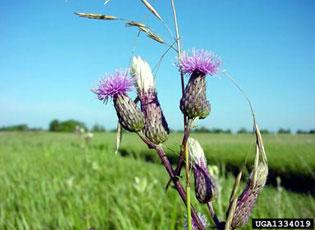
Canada thistle, flowers in South Dakota
Photo by Chris Evans; University of Illinois
Find more images
Distribution / Maps / Survey Status
All Resources
Selected Resources
The section below contains highly relevant resources for this species, organized by source.
Council or Task Force
Partnership
Federal Government
State and Local Government
Academic
Professional
Integrated Taxonomic Information System.Cirsium arvense. [Accessed Apr 6, 2023].
Moore, R.J. 1975. The biology of Canadian weeds: 13. Cirsium arvense (L.) Scop. Canadian Journal of Plant Science 55(4):1033-1048.
Jacobs, J., J. Sciegienka, and F. Menalled. 2006. Ecology and Management of Canada thistle [Cirsium arvense (L.) Scop.] [PDF, 977KB]. Invasive Species Technical Note No. MT-5. USDA. National Resources Conservation Service.
Stachion, W.J. and R.L. Zimdahl. 1980. Allelopathic activity of Canada thistle (Cirsium arvense) in Colorado. Weed Science 28:83-86.