
Arundo donax L. (ITIS)
Giant reed, Spanish reed
Thought to be native to eastern Asia (Polunin & Huxley 1987)
Early 1800's (Mariani et al. 2010)
Introduced for erosion control (Mariani et al. 2010)
Crowds out native plants species; reduces wildlife habitat; contributes to higher fire frequency and intensity; and modifies river hydrology (Giessow et al. 2011)
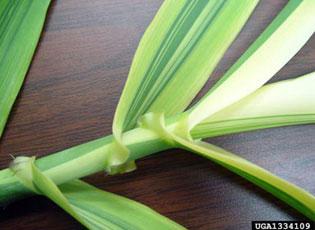
Giant reed, clasping leaf bases in Tift County, Georgia
Photo by Chris Evans; University of Illinois
Find more images
Distribution / Maps / Survey Status
All Resources
Selected Resources
The section below contains highly relevant resources for this species, organized by source.
Council or Task Force
Partnership
Federal Government
International Government
State and Local Government
Academic
Giessow, J., J. Casanova, R. Leclerc, R. MacArthur, G. Fleming, J. Giessow (Else). 2011. Arundo donax (giant reed): Distribution and Impact Report. Prepared by the California Invasive Plant Council for the State Water Resources Control Board. Agreement No. 06-374-559-0.
Integrated Taxonomic Information System. Arundo donax. [Accessed Sep 16, 2023].
Mariani, C., R. Cabrini, A. Danin, P. Piffanelli, A. Fricano, S. Gomarasca, M. Dicandilo, F. Grassi, and C. Soave. 2010. Origin, diffusion and reproduction of the giant reed (Arundo donax L.): a promising weedy energy crop. Annals of Applied Biology 157:191-202.
Polunin, O. and A. Huxley. 1987. Flowers of the Mediterranean. London: Hogarth Press.