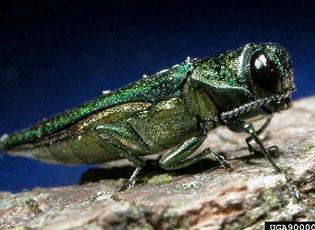
Three Tennessee counties have been quarantined for Emerald Ash Borer (EAB) after detection of the forest-devastating insect, bringing the total number of Tennessee counties under a state and federal EAB quarantine to 62. Cheatham, Giles, and Maury counties have been added to the list of areas restricted for the movement of firewood, ash nursery stock, ash timber, and other material that can spread EAB. The tree-killing beetle was recently found in these three counties through the United States Department of Agriculture’s EAB detection program.
Emerald Ash Borer Resources
Displaying 1 to 20 of 80
Search HelpTennessee Department of Agriculture.
USDA. Blog.
Humans adores trees. But humans also migrate and trade, habits that led to the accidental introduction of insects and diseases that harm trees and alter the landscape. Examples are easy to find and may be outside your front door: American elms that once dotted streets across America succumbed to Dutch elm disease. Now all colors of ash species – black, green, white, pumpkin, and blue – are threatened by emerald ash borer. The already uncommon butternut tree, also known as white walnut, faces the possibility of extinction from a mysterious attacker. Many invasive insects and fungi come from regions where native trees have evolved to resist their attacks. When these species enter the United States, they find trees that lack this resistance. There's no immediate end to this dismal pipeline, but there is hope on the horizon.
USDA. Agricultural Research Service.
Emerald ash borer (EAB) is an invasive insect from Asia that kills ash trees. EAB was first detected in North America in 2002. Several tiny wasp species are helping to control EAB.
USDA. FS. Northern Research Station.
Select the non-indigenous forest pest to view maps depicting state and county distribution. Produced by: USDA, FS, Forest Health Protection, and its partners.
USDA. Animal and Plant Health Inspection Service.
The U.S. Department of Agriculture's Animal and Plant Health Inspection Service (APHIS) is changing its approach to fight the emerald ash borer (EAB) infestation that has spread through much of the United States. The Agency is publishing a final rule that removes the federal domestic EAB quarantine regulations that have proved ineffective and will redirect resources to more promising methods. Removing the quarantine regulations ends APHIS' domestic regulatory activities, which includes actions such as issuing permits, certificates and compliance agreements, making site visits, and conducting investigations of suspected violations.
The final rule and the response to the comments we received will publish in the Federal Register on December 15, 2020 and be rule will be effective on January 14, 2021. Documents may be viewed online at https://www.regulations.gov/docket/APHIS-2017-0056 upon publication.
For more information, see: Questions and Answers: Changes in the Approach toward Fighting the Emerald Ash Borer (Dec 2020; PDF | 692 KB)
Delaware Department of Agriculture.
A destructive, invasive beetle that kills ash trees, the emerald ash borer (EAB), has been confirmed in Delaware, making it the 28th state to have found the insect, the Delaware Department of Agriculture announced today. Delaware will be added to a federal quarantine already in 27 other states restricting the interstate shipment of all ash wood and wood products - ash nursery stock, green lumber, waste, compost and chips - as well as hardwood firewood of all species.
Pennsylvania State University.
Despite the devastating impact of the invasive emerald ash borer on forests in the eastern and midwestern parts of the United States, climate change will have a much larger and widespread impact on these landscapes by the year 2100, according to researchers.
Nature Conservancy.
The Don’t Move Firewood campaign is an outreach partnership managed by The Nature Conservancy. The overarching goal of the campaign is to protect trees and forests all across North America from invasive insects and diseases that can travel in or on contaminated firewood. The central tenet of the Don’t Move Firewood campaign is that everyone has a role to play in slowing the spread of invasive tree killing insects and diseases, through making better informed firewood choices. For more information on how you can do your part, please visit our Frequently Asked Questions.
See also: Top 5 Emerald Ash Borer Awareness Week Ideas for 2021 -- During Emerald Ash Borer Awareness Week (May 23- 29, 2021) everyone is encouraged to take a few minutes to learn about the signs and symptoms of emerald ash borer infestation on ash trees, so that the infestations can be better managed by local tree professionals and foresters.
Nature Conservancy.
Emerald Ash Borer Awareness Week is in May each year. Provides outreach materials for EAB EAB Awareness Week.
USDA. FS. Southern Research Station. CompassLive.
Electronic noses are sensitive to a vast suite of volatile organic compounds that every living organism emits. A new USDA Forest Service study shows that e-noses can detect emerald ash borer (Agrilus planipennis) larvae lurking under the bark – an early, noninvasive detection method. "The results were quite spectacular," says Dan Wilson, a research plant pathologist and lead author of the study. The findings were published in the journal Biosensors.
Colorado Department of Agriculture. Division of Plant Industry.
Emerald Ash Borer (EAB) was found in Boulder, CO, in September 2013. As a non-native insect, EAB lacks predators to keep it in check. EAB only attacks ash trees in the genus Fraxinus (so mountain ash are not susceptible). EAB is responsible for the death of millions of ash trees in the Midwest. Help protect Colorado's ash trees! Don't move firewood, and consider chemical treatments to protect high-value ash trees.
Iowa State University. Extension and Outreach. Pesticide Safety Information Program.
Pennsylvania Department of Conservation and Natural Resources.
The emerald ash borer is a half-inch long metallic green beetle with the scientific name Agrilus planipennis Fairmaire. Larvae of this beetle feed under the bark of ash trees. Their feeding eventually girdles and kills branches and entire trees. Emerald ash borer was first identified in North America in southeastern Michigan in 2002.
An official website of the United States government.