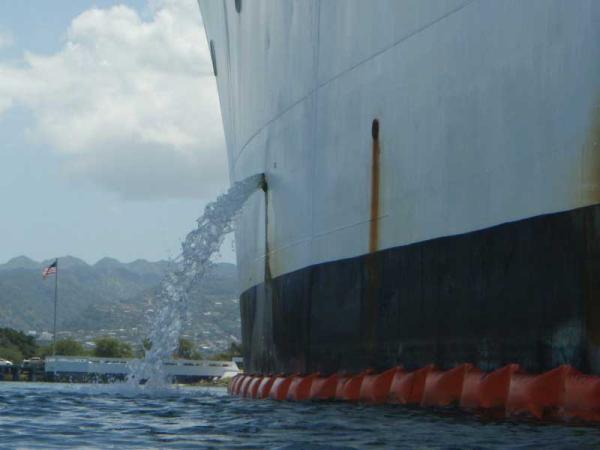
Amendments to an international treaty aimed at preventing the spread of potentially invasive species in ships' ballast water entered into force on 13 October 2019. The International Convention for the Control and Management of Ships' Ballast Water and Sediments, 2004 (the BWM Convention) was adopted by the International Maritime Organization (IMO), a specialized agency of the United Nations, to address this problem. The BWM Convention entered into force in 2017. The amendments formalise an implementation schedule to ensure ships manage their ballast water to meet a specified standard ("D-2 standard") aimed at ensuring that viable organisms are not released into new sea areas, and make mandatory the Code for Approval of Ballast Water Management Systems, which sets out how ballast water management systems used to achieve the D-2 standard have to be assessed and approved. This will help ensure that aquatic organisms and pathogens are removed or rendered harmless before the ballast water is released into a new location – and avoid the spread of invasive species as well as potentially harmful pathogens.
Ballast Water
Ballast water is one of the major pathways for the introduction of nonindigenous marine species. Ballast water is fresh or saltwater held in the ballast tanks and cargo holds of ships. It is used to provide stability and maneuverability during a voyage when ships are not carrying cargo, not carrying heavy enough cargo, or when more stability is required due to rough seas. Ballast water may also be used to add weight so that a ship sinks low enough in the water to pass under bridges and other structures.
Usually, ballast water is pumped into ballast tanks when a ship has delivered cargo to a port and is departing with less cargo or no cargo. Ballast water is then transported and released at the next port-of-call where the ship picks up more cargo. If a ship is receiving or delivering cargo to a number of ports, it may release or take on a portion of ballast water at each port. In such cases, the shipís ballast water contains a mix of waters from multiple ports.
The release of ballast water may introduce non-native organisms into the port of discharge. These introduced species, or bioinvaders, are also referred to as exotic species, alien species, and nonindigenous species. (Source: Massachusetts Institute of Technology Sea Grant - Ballast Water)
Spotlights
International Maritime Organization.
Selected Resources
The section below contains highly relevant resources for this subject, organized by source. Or, to display all related content view all resources for Ballast Water
Partnership
Pacific States Marine Fisheries Commission.
GloBallast Partnerships Programme.
Building Partnerships to Assist Developing Countries to Reduce the Transfer of Harmful Aquatic Organisms in Ships’ Ballast Water, simply referred to as GloBallast Partnerships (GBP), was initiated in late 2007 and is intended to build on the progress made in the original project. This was initially planned as a five-year project, from October 2007 to October 2012, but was extended until June 2017.
International Maritime Organization; United Nations Development Programme; Global Environment Facility.
GloFouling Partnerships is part of the wider efforts by the International Maritime Organization (IMO), in collaboration with the United Nations Development Programme (UNDP) and the Global Environment Facility (GEF), to protect marine ecosystems from the negative effects of invasive species. This work began in 2001 under the GloBallast Programme.
Federal Government
U.S. Government Printing Office. Federal Depository Library Program Electronic Collection Archive.
Compiled and Edited by: Gregory Ruiz and David Reid, NOAA Technical Memorandum GLERL-142.
See also: GLERL Technical Reports for more reports
Environmental Protection Agency.
The EPA's National Pollutant Discharge Elimination System (NPDES) Vessel General Permit (VGP) and Small Vessel General Permit (sVGP) regulate discharges incidental to the normal operation of commercial vessels, including ballast water and hull fouling, which are both pathways for introductions of aquatic nuisance species. The EPA and the Department of Defense are jointly developing the Uniform National Discharge Standards for vessels of the Armed Forces which will also regulate ballast water and hull fouling to help control the introduction of aquatic nuisance species.
Note: On December 4, 2018, President Trump signed into law the Frank LoBiondo Coast Guard Authorization Act of 2018, which includes as Title IX the Vessel Incident Discharge Act of 2018 (“VIDA”). The new regulations will replace the EPA’s 2013 Vessel General Permit (“VGP”). EPA first issued the Vessel General Permit (VGP) in 2008 and subsequently reissued it in 2013.
International Government
State and Local Government
Michigan Department of Environment, Great Lakes, and Energy.
California Department of Fish and Wildlife. Office of Spill Prevention and Response.
An official website of the United States government.