An official website of the United States government
Here's how you know
Official websites use .gov
A .gov website belongs to an official government organization in the United States.
Secure .gov websites use HTTPS
A lock ( ) or https:// means you’ve safely connected to the .gov website. Share sensitive information only on official, secure websites.
Provides access to all site resources, with the option to search by species common and scientific names. Resources can be filtered by Subject, Resource Type, Location, or Source. Search Help
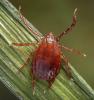
In November of 2017, a tick species previously unknown to the US called Haemaphysalis longicornis, or the Asian longhorned tick, was discovered both on a sheep and in a pasture in New Jersey. Since then, this new tick species has been found in eight additional states, including 17 counties and one city in Virginia.
Rhode Island Department of Environmental Management.
The Rhode Island Department of Environmental Management (DEM) today announced that the longhorned tick, an exotic pest from Asia, has been found for the first time in New England. Working in cooperation with the Animal and Plant Health and Inspection Service (APHIS) of the US Department of Agriculture (USDA), DEM is asking livestock producers and wildlife rehabilitators to observe animals for the presence of the tick.
South Carolina public health and livestock officials have recently identified a large population of Asian longhorned ticks infesting a pasture at a cattle farm in York County. This invasive species of tick is not commonly found in the United States, and bites from these ticks have caused illnesses in people, animals and livestock in other countries. As of June 2022, the U.S. Department of Agriculture (USDA) reports Asian longhorned ticks were first identified in the United States in 2010 and have since been found in 17 states. In South Carolina, a small number of these ticks were identified in 2020 on shelter dogs in Lancaster and Pickens counties.
To help state officials learn more about the prevalence of Asian longhorned ticks in South Carolina, residents are asked to carefully submit ticks suspected to be Asian longhorned ticks for confirmatory identification. This surveillance will help determine tick species presence, distribution, seasonality, and potential tick-borne disease risks.
The Asian longhorned tick is native to eastern Asia. It was first detected in New Jersey in 2017. The full public health and agricultural impact of this tick and spread is unknown. It is a potential vector of several human and animal diseases present in the U.S.
Tests by the National Veterinary Services Laboratory in Ames, Iowa have confirmed the presence of Asian, or longhorn tick, Haemaphysalis longicornis, in Pennsylvania. An invasive species that congregates in large numbers and can cause anemia in livestock, the tick was discovered on a wild deer in Centre County. It is known to carry several diseases that infect hogs and cattle in Asia. So far, ticks examined in the U.S. do not carry any infectious pathogens. Native to East and Central Asia, the tick was originally identified in the U.S. in New Jersey, where it was found in large numbers in sheep in Mercer County in 2017. It has also been found in Arkansas, New Jersey, New York, West Virginia and Virginia.
Ticks may not seem dangerous, but they can cause disease and even death in livestock and pets. There are hundreds of tick species in the world, about 10 percent of these species are found in the United States. Now there’s one more to watch out for. In 2017, the U.S. Department of Agriculture (USDA) confirmed the presence of the Asian longhorned tick (Haemaphysalis longicornis). It probably arrived in the United States in or before 2010. Exactly how or when is unknown, but one thing is certain: it may have entered on domestic pets, horses, livestock or people. While we know the impact of this tick in other parts of the world, we are still studying how they may affect U.S. agriculture, and our environment. See related resource: Data Visualization Tools to explore plant and animal health management data and interactive story maps
National Invasive Species Council. Invasive Species Advisory Committee.
Although the scientific literature has relatively few publications on the subject, the expanding distribution of ticks and their associated disease-causing pathogens are increasingly shown to be facilitated by the presence of certain invasive plant species, particularly plant understory and transition-zone species. Invasive species have been found to contribute to the spread and survival of ticks, hosts, and various disease-causing pathogens. For those species that have been investigated, several invasive plant species such as Japanese honeysuckle and barberry have been definitively shown to harbor and enhance tick, host, and pathogen populations by enhancing microhabitat and survival. Additionally, non-native tick species such as Asian longhorn tick have been introduced and potentially new invasive tick-borne pathogens or hosts can, and likely will, be introduced in the future. For more publications, see ISAC White Papers.
Rhode Island Department of Environmental Management.
The Rhode Island Department of Environmental Management (DEM) is announcing that two exotic species of Asian and Eurasian ticks have been detected for the first time on Block Island. It was confirmed by DNA and morphological characteristics that they are ticks not previously found in Rhode Island. Dr. Danielle M. Tufts identified the tick species Haemaphysalis longicornis and Haemaphysalis punctata when studying ticks on Block Island this summer.
Haemaphysalis longicornis, also called the Asian longhorned tick, was first detected in the United States in 2017 in New Jersey. Haemaphysalis punctata is native to Europe and has not been previously detected in a natural setting in North America. H. punctata is sometimes known as the "red sheep tick" in its native range. The center of its distribution is the southern half of Europe, including England, and there are some established populations along North African coastal areas. The finding on Block Island is notable because this tick is not known to exist outside of its home range.
DHHS. CDC. Division of Vector-Borne Diseases (DVBD).
The U.S. Department of Health and Human Services released the National Public Health Strategy to Prevent and Control Vector-Borne Diseases in People (VBD National Strategy). As directed by the 2019 Kay Hagan Tick Act—named after the U.S. Senator who died due to complications from a tickborne illness—HHS led a four-year process with civilian agencies and defense departments to deliver this strategy. Co-led by the HHS Office of the Assistant Secretary for Health and the Centers for Disease Control and Prevention, the strategy identifies and describes federal priorities to detect, prevent, respond to, and control diseases and conditions caused by vectors in the United States. This VBD National Strategy represents the largest formal federal coordination effort focused on vector-borne disease prevention and control with contributions by over 50 representatives across 17 federal agencies. See also: U.S. Health and Human Services Press Release on VBD National Strategy (Feb 6, 2024)