An official website of the United States government
Here's how you know
Official websites use .gov
A .gov website belongs to an official government organization in the United States.
Secure .gov websites use HTTPS
A lock ( ) or https:// means you’ve safely connected to the .gov website. Share sensitive information only on official, secure websites.
Provides access to all site resources, with the option to search by species common and scientific names. Resources can be filtered by Subject, Resource Type, Location, or Source. Search Help
African swine fever is a deadly pig disease that spreads rapidly and affects domestic and wild swine. While not a threat to human health, the virus could devastate America’s swine, pork industry, and food supply. Whatever pigs mean to you—your livelihood or a pet—we’re all in it together. Protect our swine and keep the disease out of the United States.
A draft integrated letter report and programmatic environmental assessment has been developed to determine the economic and environmental impacts of federal participation in state-managed watercraft inspection programs along the Upper Missouri River Basin in Montana, Wyoming, North Dakota, South Dakota and Nebraska. Public comments on the draft EA were accepted until March 2, 2021.
The existing watercraft inspection programs are managed collaboratively by the states of Montana, Wyoming, North Dakota, South Dakota and Nebraska, where watercraft transported along highways are inspected for the presence of aquatic invasive species and decontaminated when detected. If approved, federal participation in the program would be cost-shared (50 percent) with each of the states, and would employ a regional strategy to identify locations that would provide the greatest likelihood of preventing the spread of aquatic invasive species to reservoirs operated and maintained by the Corps in the Upper Missouri River Basin.
Yellowstone National Park seeks public comment on proposed measures to help stop the spread of aquatic invasive species (AIS) into park waters. The proposals include a 30-day mandatory dry time for some types of motorized boats and sailboats before entering park waters and the prohibition of watercraft previously fouled by mussels regardless of dry time.
Read about Forest Service's research highlights. Can filter and sort by Topic, keywords, year, research unit, and more. See also: Additional highlights for related topics Pest Management and Plant Diseases
For more than 30 years, the U.S. Fish and Wildlife Service has worked with Vermont and New York to control this invasive species and protect Lake Champlain. Fortunately, sea lamprey woundings are now at an all-time low.
The U.S. Geological Survey provides natural-resource managers with scientific information, risk assessment, and tools that can help to improve surveillance, prevention, and control strategies for managing invasive carp. Fact Sheet 2022–3012
The plot could have come from Hollywood — an insidious alien invader threatens to overrun the land, but intrepid scientists discover a secret weapon in the far-off, exotic land of Nepal and bring the pestilence to heel. But this is not fiction; it's true. The air potato plant (Dioscorea bulbifera) is an exotic vine from Asia that was introduced to Florida about 115 years ago to make medicine. After escaping from the lab, it multiplied and smothered native plant communities in all of Florida's 67 counties. It spread beyond to large swaths of land in the southeastern United States. All attempts to manage the air potato – mechanical, chemical, or physically gathering the bulbils — were unsuccessful; they were either too labor intensive and costly or caused collateral damage to native and endangered species. According to Min Rayamajhi, a plant pathologist at the Agricultural Research Service's (ARS) Invasive Plant Research Laboratory (IPRL) in Fort Lauderdale, FL, the vines return every season, repeating the growth cycle and expanding the invasion at a rate of about 6 inches per day. Rayamajhi and retired ARS scientist Bob Pemberton traveled to Nepal and accidentally discovered the air potato beetle.
The SCIENCEx webinar series brings together scientists and land management experts from across U.S. Forest Service research stations and beyond to explore the latest science and best practices for addressing large natural resource challenges across the country. These webinars are primarily management-focused, but with applicability for participants from across sectors.
SCIENCEx Climate Change -- October 25-29, 2021 (archived)
Biologists from the U.S. Geological Survey are racing the clock to pull four species of native Hawaiian Honeycreeper forest birds back from the brink of extinction. Factors such as habitat loss, invasive species, and non-native predators have been fueling the birds' decline for centuries. However, introduced diseases, particularly avian malaria spread through mosquitos, which are not native to the Hawaiian Islands, coupled with climate change, are the greatest threat facing Hawaiian forest birds today.
"As the climate warms and more mosquitoes move into the once malaria-free regions of the mountains, healthy birds are running out of places to escape the cycle of infection," said Eben Paxton, a research ecologist with the USGS Pacific Island Ecosystems Research Center (PIERC) in Hawai'i. Now, PIERC biologists are working with a range of partners, including other Interior Department bureaus and the Birds Not Mosquitos Coalition, to intercept the disease cycle using a novel conservation tool.
A map identifying the areas suitable for establishment of the spotted lanternfly (SLF) in the United States and other countries has been published in the Journal of Economic Entomology by Agricultural Research Service scientists. The SLF, originally from China, has spread to Korea and Japan, and has been found most recently in the United States in Pennsylvania, New Jersey, Virginia and Delaware. These insects are pests of many agricultural crops including almonds, apples, blueberries, cherries, peaches, grapes and hops as well as hardwoods such as oak, walnut and poplar, among others. USDA and State partners have been working to contain SLF populations since 2014. There is the potential for far reaching economic damage if the SLF becomes widely established in the United States.
USDA. FS. Northern Research Station. Rooted in Research.
Seed banks can provide insight into a forest’s past and give land managers valuable information to help them plan for the forest’s future. For example, knowing which species may germinate after future fires is valuable, especially when nonnative invasive species in the seed bank could proliferate quickly following disturbances.
In this study, researchers analyzed the species composition of buried seeds and extant vegetation present in areas that have faced differing fire conditions over many years on the Monongahela National Forest in West Virginia.
USDA. Forest Service. Gen. Tech. Rep. RMRS-GTR-429.
A guide to selecting native plants desired by native bees. This framework can be used to assess pollinator friendliness of native plant species for forests, public lands, and other areas.
Injurious wildlife provision of the Lacey Act provides effective tool to halt the introduction and spread of species that have been identified as imminent and serious threats. The U.S. Fish and Wildlife Service took action to help ensure 10 nonnative freshwater fish species and one nonnative freshwater crayfish species do not become established in the United States and damage native wildlife and habitats.
The U.S. Fish and Wildlife Service is announcing a $100,000 challenge to combat white-nose syndrome (WNS), a lethal fungus that has killed millions of bats in North America and pushed some native bat species to the brink of extinction. Funding will be awarded to individuals who identify innovative ways to permanently eradicate, weaken or disarm the disease.
There is no known cure for white-nose syndrome, but scientists worldwide are working together to study the disease and how it can be controlled. Much of this work has been conducted under the umbrella of the U.S. National Response to White-nose Syndrome, a broad, multi-agency effort led by the Service.
The deadline for individuals or teams to enter the challenge was Dec.31, 2019. Winning ideas will be the focus of future collaborations with scientists, designers and engineers to bring solutions to life. Additional information regarding rules and eligibility is available at White-nose Syndrome Challenge.
The U.S. Fish and Wildlife Service announced a proposal to list the tricolored bat as endangered under the Endangered Species Act (ESA). The species faces extinction due primarily to the range-wide impacts of white-nose syndrome, a deadly disease affecting cave-dwelling bats across the continent.
Bats are essential for healthy ecosystems and contribute at least $3 billion annually to the U.S. agriculture economy through pest control and pollination. The growing extinction crisis highlights the importance of the ESA and efforts to conserve species before declines become irreversible. See also: Related story (Sep 13, 2020) - How the USFWS and its partners are working to keep this little bat from vanishing forever
The spongy moth, (Lymantria dispar), formerly known as the "gypsy moth," continues to spread throughout North America, threatening deciduous trees and impacting humans. This non-native, foliage-feeding insect currently occupies only about one-third of its possible host distribution in the United States. Efforts to reduce its impact and spread represent one of the largest and most successful federal and state agency integrated pest management programs against a forest pest.
This new General Technical Report (GTR), published by the Northern Research Station, synthesizes information about the Slow the Spread Program, its accomplishments, and provides a framework for future landscape-level integrated pest management. See related resource: National Slow The Spread (STS) Program
Citation: Coleman, Tom W.; Liebhold, Andrew M., eds. 2023. Slow the spread: a 20-year reflection on the national Lymantria dispar integrated pest management program. Gen. Tech. Rep. NRS-212. Madison, WI: U.S. Department of Agriculture, Forest Service, Northern Research Station. 130 p. https://doi.org/10.2737/NRS-GTR-212.
Inadvertently introduced in the northeastern United States in the 1930s, mile-a-minute weed is a highly aggressive invasive plant that is replacing native species in many areas of the Nation. While a biocontrol agent has been identified, finding and reaching dense patches of mile-a-minute weeds has been a problem for land managers. The solution may be drones carrying environmentally friendly pods packed with tiny weevils.
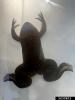
The African clawed frog was first discovered in California in 1968. It was imported for laboratory research and the pet trade. This species can negatively impact native amphibian and fish populations.
African swine fever was first identified in Kenya in 1921 and spread among domestic and wild pigs. This disease is a highly contagious and fatal viral disease affecting domestic and wild pigs; one of the most economically devastating diseases of swine. African swine fever has never been found in the U.S. Illegal entry of swine products and byproducts presents the largest potential pathway for the entry of African swine fever virus.
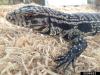
The Argentine black and white tegu is native to South American and the first established population in the U.S. was documented in Florida in 2006. It's means of introduction was via the pet trade and the Argentine black and white tegu is a generalist omnivore that preys on many native species.